AM/PM to 24-Hour Time – Elementary Math Tutoring Guide
Learn to convert AM/PM time to the 24-hour clock step by step with a free lesson that has clear rules, animated examples and practice
By L W (Lim)
Published: 20 Nov. 2026
How to Convert AM/PM Time to 24-Hour Time
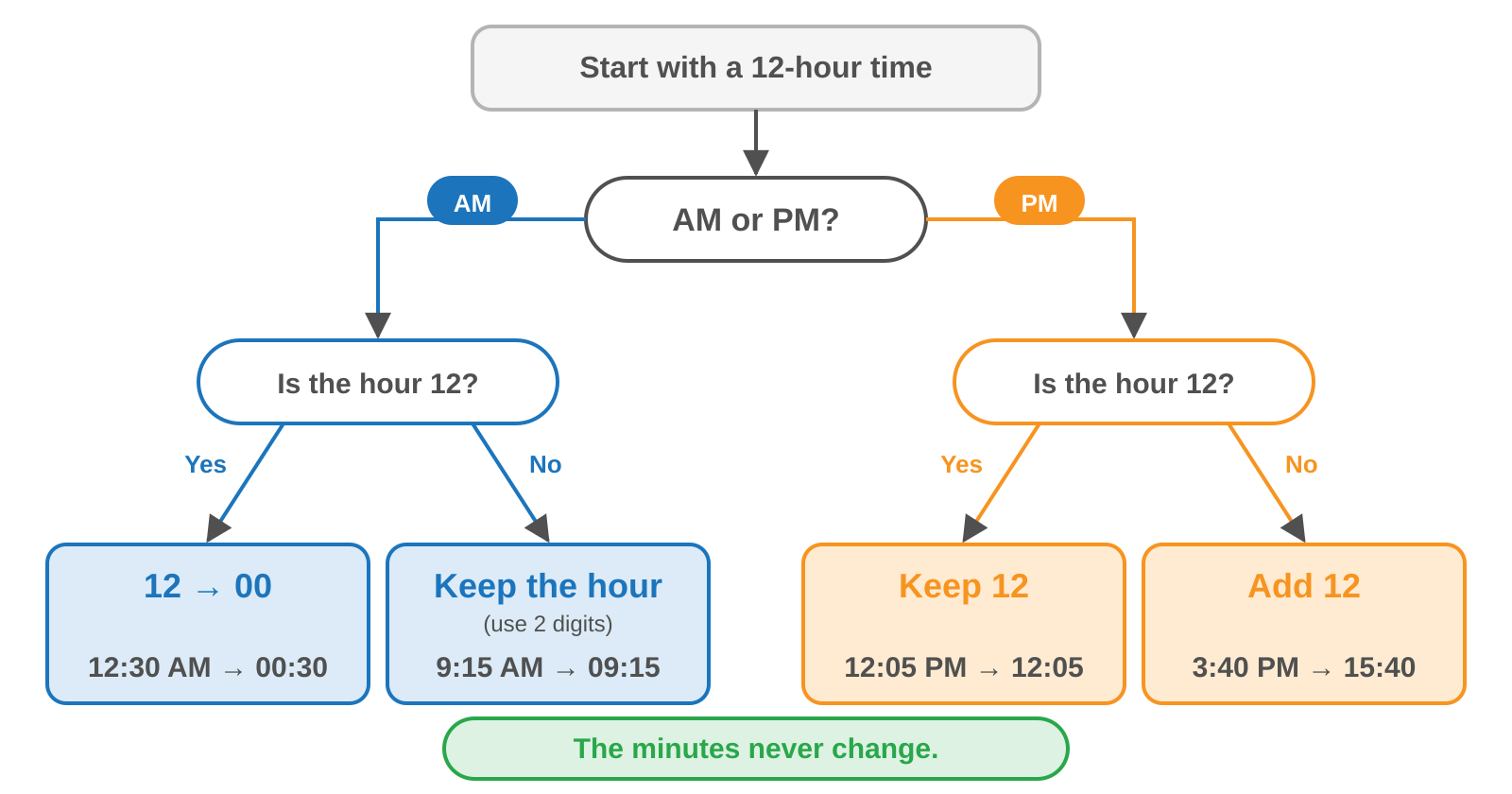
To change a 12-hour time into 24-hour time, look at AM or PM. For AM times, keep the hour, but 12 AM becomes 00. For PM times, add 12 to the hour, but 12 PM stays 12. The minutes never change.
Two ways to tell the time
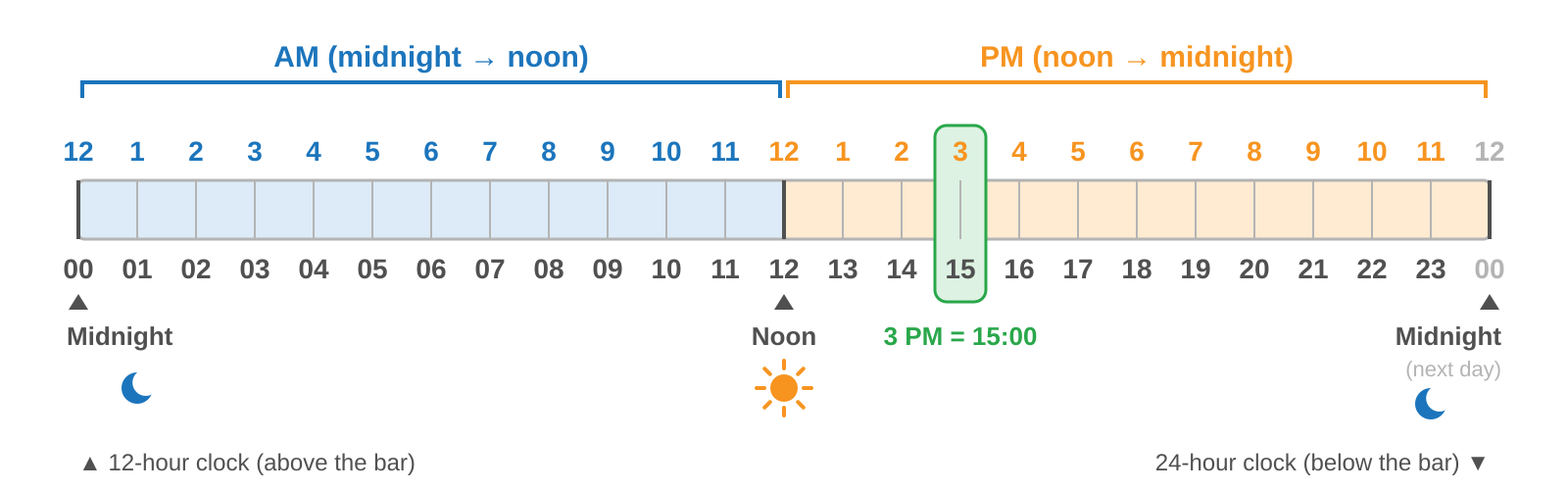
A day has 24 hours. The 12-hour clock counts from 12 up to 11 two times every day, so we add AM or PM to show which half of the day we mean:
AM (ante meridiem, Latin for "before midday") is from midnight until just before noon.
PM (post meridiem, "after midday") is from noon until just before midnight.
The 24-hour clock does not need AM or PM. It starts at 00 at midnight and keeps counting up to 23, then starts again. You will see it on train and bus timetables, plane tickets, phones and computers. In Thailand, 24-hour times are often written with a dot instead of a colon, for example 15.40 น.
Figure 1. The same day on both clocks. After noon, the 24-hour number is 12 more than the 12-hour number: 3 PM is 15:00.
The four rules for converting AM/PM to 24-hour time
Ask two questions: Is it AM or PM? and Is the hour 12? Then follow the chart. In every case, the minutes stay the same. Only the hour can change.
Figure 2. Ask two questions: AM or PM? Is the hour 12?
Watch out for 12:xx. Times from 12:00 to 12:59 are the special cases. 12:xx AM (just after midnight) becomes 00:xx, and 12:xx PM (just after noon) stays 12:xx. For every other hour, AM stays the same and PM adds 12.
Step-by-step examples
Press Next to see each example. Watch which number the clock hands point to on the inner and outer rings.
The big idea
One day = 24 hours
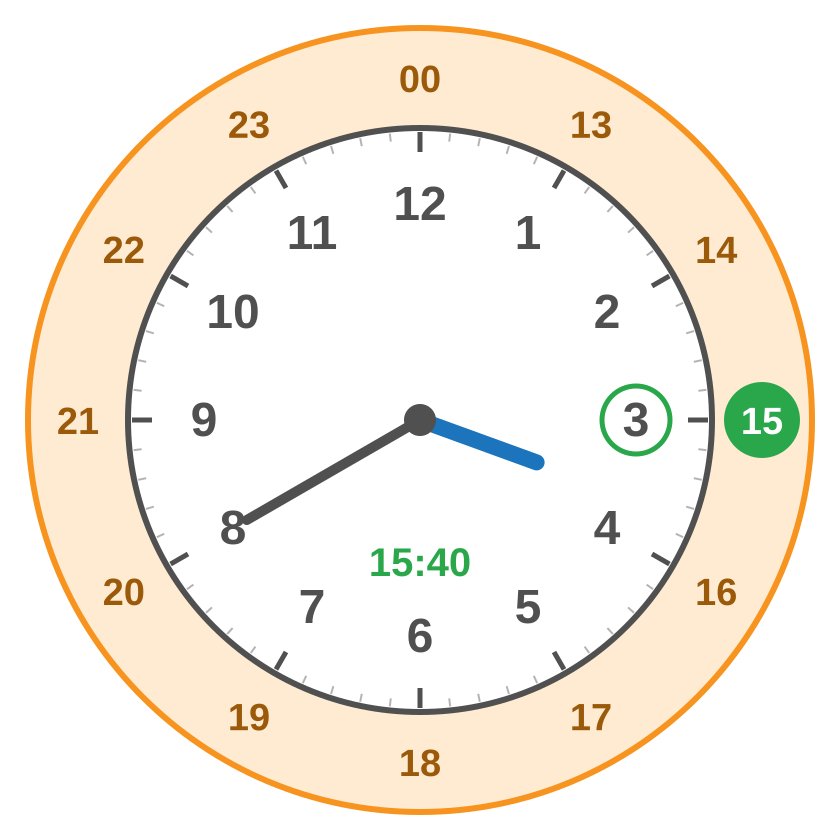
The inner ring (1–12) is the 12-hour clock. It goes around twice a day, so we add AM or PM.
The outer ring shows the PM hours on the 24-hour clock: 13, 14, … 23.
Each outer number is 12 more than the inner number next to it.
Example 1 · Morning
9:15 AM
It is AM and the hour is not 12.
Keep the hour. Write it with two digits: 9 → 09
Keep the minutes: 15
9:15 AM = 09:15
Example 2 · Afternoon
3:40 PM
It is PM and the hour is not 12.
Add 12 to the hour: 3 + 12 = 15
Keep the minutes: 40
3:40 PM = 15:40
Example 3 · Late at night
11:59 PM
It is PM and the hour is not 12.
Add 12 to the hour: 11 + 12 = 23
Keep the minutes: 59
11:59 PM = 23:59
One minute later it is midnight: 00:00.
Watch out! · Just after midnight
12:30 AM
It is AM and the hour is 12.
12 AM is the first hour of the day, so 12 → 00
Keep the minutes: 30
12:30 AM = 00:30
Watch out! · Just after noon
12:05 PM
It is PM and the hour is 12.
Do not add 12. Noon is already hour 12.
Keep the minutes: 05
12:05 PM = 12:05
Going back · 24-hour → AM/PM
18:45
The hour is more than 12, so it is PM.
Subtract 12 from the hour: 18 − 12 = 6
Keep the minutes: 45
18:45 = 6:45 PM
Remember
The four rules
AM hour 12
change 12 to 00
12:30 AM → 00:30
AM hour 1–11
keep the hour (2 digits)
9:15 AM → 09:15
PM hour 12
keep 12
12:05 PM → 12:05
PM hour 1–11
add 12
3:40 PM → 15:40
The minutes never change.
How to convert 24-hour time back to AM/PM
To go the other way, look at the hour:
24-hour time
What to do
Example
00:00 to 00:59
Change 00 to 12 and write AM
00:45 → 12:45 AM
01:00 to 11:59
Keep the hour and write AM
07:05 → 7:05 AM
12:00 to 12:59
Keep 12 and write PM
12:20 → 12:20 PM
13:00 to 23:59
Subtract 12 and write PM
18:45 → 6:45 PM
Figure 3. A 24-hour clock face. Each outer number is 12 more than the inner number beside it. At the top, 12 on the inner ring is noon, and 00 on the outer ring is midnight.
Try it yourself
Choose a time and see the answer and the rule that was used.
:
=
:
=
Common mistakes
12 AM is not 12:00. 12 AM is midnight, so it is 00:00. The time 12:00 is noon (12 PM).
Don't add 12 to 12 PM. 12:45 PM is 12:45, not 24:45.
Don't add 12 to AM times. 8:00 AM is 08:00, not 20:00.
Don't change the minutes. 4:35 PM is 16:35.
Use two digits for the hour. In 24-hour time we usually write 07:05, not 7:05.
12 AM is midnight, the start of the day. In 24-hour time it is 00:00. 12 PM is noon, which is 12:00.
What does 24:00 mean?
Some timetables write 24:00 for the very end of a day. 24:00 on Monday is the same moment as 00:00 on Tuesday. Clocks and phones show it as 00:00.
Why do people use the 24-hour clock?
Each time of day has only one name, so there is no mix-up between morning and evening. That is why it is used for trains, flights, hospitals and computers, and in many countries, including Thailand.
What is the quickest way to convert 24-hour time to 12-hour time?
If the hour is bigger than 12, subtract 12 and write PM. For example, 20:10 is 8:10 PM.